By Kailash | About me | Last updated: 19 October 2026
Results are out, and suddenly every relative has become a career counsellor.
“Take science, it has the most scope.” “Take commerce, it’s the safe choice.” “Don’t take arts.” Every year, lakhs of students pick a stream based on whoever advised the loudest. Two years later, many sit in the wrong classroom, stressed and stuck.
Which stream to choose after 10th depends on what you enjoy, what your family can support, and how tough the competition is. Here are all four options with verified 2025 numbers. No stream is good or bad on its own. Each one fits some students and drains others.
Short answer: Don’t decide in a hurry. Choose the stream you’re interested in, and pick a route your family can support until the end, so you never have to quit halfway and start a new subject. PCM suits maths and problem-solving, PCB suits medical and life sciences, Commerce suits business and money, and Arts suits people, language and policy. Keep one backup plan in every stream.
Which stream to choose after 10th: the four options at a glance
| Stream | Pick it if… | The hard truth |
|---|---|---|
| Science (PCM) | You enjoy maths and problem-solving | JEE Main 2025: 15.4 lakh registered. JoSAA 2025 offered about 59,900 seats across IITs, NITs, IIITs and GFTIs, of which 17,760 were in IITs |
| Science (PCB) | You want medical or life sciences and can memorise well | NEET UG 2025: 20.9 lakh appeared for roughly 1.2 to 1.3 lakh MBBS seats, about 16 to 18 candidates per seat |
| Commerce | You like business, money and accounts | CA is widely considered one of the toughest exams in India |
| Arts/Humanities | You enjoy history, politics, literature and people | UPSC 2024: about 13.4 lakh applied for roughly 1,056 posts |
Sources: NTA JEE Main and JoSAA for engineering seats, NTA and NMC for NEET UG and MBBS seats, UPSC for CSE 2024.
Don’t rush: choose by interest and by what your family can support
Don’t decide in a hurry. Results day is noisy, and everyone around you has an opinion. Check your school’s admission deadline, then use the time before it to run the self-check below, read about each stream and talk to people.
Choose the path you’re interested in. Interest carries you through the hard months of 11th and 12th. A stream picked for someone else’s reason gets heavy very fast.
Count your family’s situation honestly. Every path has a full cost: tuition, hostel, books, coaching and living expenses for the whole course, not only the first year. Fees vary widely between government and private colleges. Ask your parents what they can support through to the end.
Pick a route you can finish. If B.Tech is beyond your family’s means, choose a path where you won’t have to leave midway and start a new subject. A dropped course costs years and money, and the second start is harder.
You can still reach a big goal in steps. A graduation your family can afford now can lead to a master’s degree or a competitive exam later.
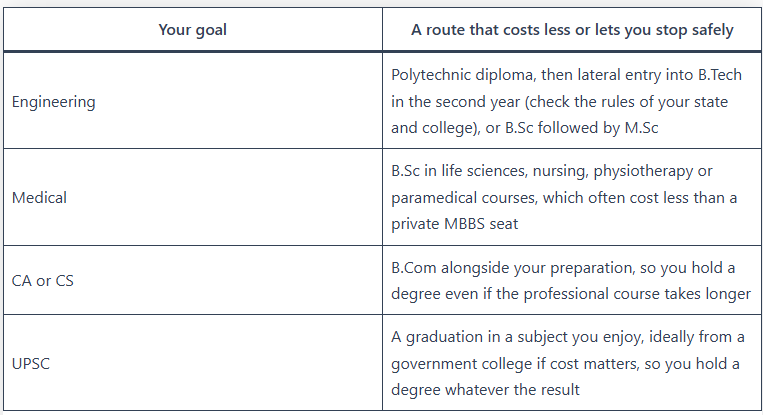
| Your goal | A route that costs less or lets you stop safely |
|---|---|
| Engineering | Polytechnic diploma, then lateral entry into B.Tech in the second year (check the rules of your state and college), or B.Sc followed by M.Sc |
| Medical | B.Sc in life sciences, nursing, physiotherapy or paramedical courses, which often cost less than a private MBBS seat |
| CA or CS | B.Com alongside your preparation, so you hold a degree even if the professional course takes longer |
| UPSC | A graduation in a subject you enjoy, ideally from a government college if cost matters, so you hold a degree whatever the result |
Admission rules differ by state and college, so confirm them before you plan. Government colleges, scholarships and education loans can lower the cost. Read the terms of any loan before you take it.
Science (PCM) after 10th: who should choose it
PCM means physics, chemistry and maths.
Pick it if: you enjoy maths and can stay with a hard problem for an hour without giving up.
Careers: engineering, architecture, defence (NDA), data science, commercial pilot.
Skip it if: the only reason is “smart students take science.” Lakhs of students take PCM under pressure and struggle for two years. If maths scares you now, it will scare you in 11th and 12th.
Reality check: An IIT seat is one route among many. JoSAA 2025 offered about 59,900 seats: 17,760 in IITs, 24,229 in NITs, 8,546 in IIITs and 9,402 in other government-funded institutes. Most PCM students build their careers through NITs, state colleges or private universities. I think skills count for more than the college tag once you’ve had your first job.
Science (PCB) after 10th: the medical route
PCB means physics, chemistry and biology.
Pick it if: you want medical, life sciences or biotechnology, and you can memorise as well as understand.
Careers: MBBS, BDS, nursing, pharmacy, biotechnology, physiotherapy, veterinary.
Reality check: In NEET UG 2025, 20.9 lakh candidates appeared and 12.36 lakh qualified. MBBS seats were about 1.16 lakh when counselling began and rose to about 1.29 lakh as new seats were added. For 2026, the NMC lists 1,36,939 MBBS seats across 823 colleges, so the odds improve slightly, but competition stays heavy.
Plan a backup from day one: B.Sc, nursing or a paramedical course. A backup plan is simply part of planning.
Commerce after 10th: who should choose it
Pick it if: you like numbers in a business setting: money, trade, accounts. You’re curious about how businesses run.
Careers: CA, CS, banking, business management (BBA/MBA), economics, stock market.
Myth: “Commerce is for weak students.” CA takes years of sustained effort and many students need several attempts. This stream rewards consistency and patience more than speed.
Arts and humanities after 10th: scope and myths
Pick it if: you enjoy history, politics, literature, psychology or social issues, and you like reading and writing.
Careers: UPSC/IAS, teaching, law, journalism, psychology, design, hotel management.
Myth: “Arts me scope nahi hai.” About 13.4 lakh people applied for roughly 1,056 UPSC posts in 2024, so the competition is real. Data given in the Rajya Sabha shows that about 63% of candidates recommended in 2017 to 2021 held engineering degrees, and roughly 85% of selected candidates chose a humanities optional. Your stream in 11th and 12th does not lock you in or out. How good you become decides the result.
Diploma and ITI after 10th
Some students choose a polytechnic diploma, typically three years, or an ITI trade course, which runs from a few months to two years depending on the trade. Both lead to jobs sooner and can be a good fit if you learn best by doing. Check that the institute is recognised before you pay a fee.
A 10-minute stream self-check
Tick every statement that is true for you today. Be honest, because nobody is checking.
| Statement | Points to |
|---|---|
| I can spend an hour on one maths problem and not feel bored | PCM |
| I enjoy building, fixing or taking things apart | PCM |
| I’m curious about the human body and want to help patients | PCB |
| I remember terms, diagrams and processes easily | PCB |
| I like understanding how shops, banks and prices work | Commerce |
| I enjoy keeping accounts or tracking money | Commerce |
| I read news, history or stories for fun | Arts |
| I like talking to people and understanding why they act the way they do | Arts |
The stream with the most ticks is a starting point. If two streams tie, or you tick very few, move to Step 2 below and talk to people who work in those fields. This is a simple self-check and no substitute for a counsellor.
Career options after 12th for Science students
Engineering (B.Tech): pick it if you like building and creating things, and if your family can support the full four years. A degree without skills gets you very little. Choose a branch you can tolerate for four years.
Medical (NEET): choose it only if you’re ready for five or more years of intense study. The competition ratio is real.
B.Sc and M.Sc: a good path for research, teaching and government jobs, and underrated.
Defence (NDA): the Army wing accepts students from any stream, while the Navy and Air Force wings need physics and maths in 12th. Check the current UPSC notification before you plan. CDS is a separate route for graduates.
Data science and AI: a growing field that needs strong maths, so it suits PCM students well.
Career options after 12th for Commerce students
CA and CS: both are demanding and take several years of steady effort. Start early.
BBA and MBA: a good route into business and management. The institute matters here, so aim for a reputed one.
Banking exams (IBPS, SBI PO): these open after graduation and offer a stable government-sector career with a clear syllabus.
Stock market and finance: this needs self-learning along with a degree. Don’t put real money in before you understand the risk.
Career options after 12th for Arts students
UPSC preparation with graduation: the classic path. Choose a graduation subject you enjoy, because you’ll read it for years.
Law (CLAT): a five-year integrated law degree. Corporate law can pay well, and litigation builds slowly but steadily.
Journalism and mass communication: a growing field with digital media. Build a portfolio early, because your published work counts for more than your marks.
Teaching: B.Ed after graduation keeps its demand, and government teacher posts open regularly.
Psychology: an emerging field, especially counselling. You need a master’s degree to practise properly.
How to decide your stream: 5 practical steps
Step 1: list what you enjoy. Write down what you can do for 3 or 4 hours without boredom. Maths problems? Reading about history? Helping people?
Step 2: check the ground reality. Talk to 2 or 3 people who work in that field, and skip the relatives who only heard about it. Ask what the daily work looks like, what the starting salary is and how hard the entry was.
Step 3: match interest with ability. Interest without ability leads to struggle, and ability without interest leads to a dull career. You need both, or an interest strong enough to build the ability.
Step 4: check the full cost with your family. Work out the total cost of the course, from 11th to the first job, and compare it with what your family can support. If the numbers don’t fit, choose the route from the table above that you can finish.
Step 5: keep one backup. A medical aspirant can keep B.Sc as a backup. A UPSC aspirant can choose a degree that also opens job options. An engineering aspirant can build coding skills alongside.
What parents should understand
If you’re a parent reading this, five points matter most.
Marks don’t decide the future. A 75% student in the right stream often does better than a 95% student in the wrong one.
Decide together with your child. A decision forced on a student can lead to stress and loss of interest.
Share the real budget. When your child knows what the family can support, the choice fits from the start and nobody has to quit halfway.
Every stream has toppers. The useful question is which stream suits your child.
Give it six months. If your child is still struggling after six months in a stream, allow a change. That’s a correction, and you should treat it as one.
Frequently asked questions -What to Do After 10th or 12th
Which stream has the most scope in 2026?
No stream has the most scope for everyone. Growing fields right now include data and AI (science), finance (commerce), and digital content and law (arts).
What if my family can’t afford my dream course?
Choose a route you can finish. A diploma with lateral entry, a B.Sc, or a graduation in a government college can lead to your goal in steps. Check scholarships and the admission rules of each college before you decide.
Can I change stream after 11th?
Yes, most schools allow it in the first few months. After 12th, you can also switch fields through entrance exams or bridge courses. Earlier is easier.
What if I choose the wrong stream?
Notice it early, talk to your parents and your school, and give the change a clear deadline. Many students switch fields after 12th through a different graduation or entrance exam.
Is it okay to take a drop year?
One drop year for a clear goal such as NEET, JEE or CLAT is fine. Two drops without a plan is risky. Think while studying.
What if I’m average in studies?
Average students succeed every day in every field. Choose something that matches your interest, work steadily and build one strong skill.
Should I follow my friends’ choice?
No. What’s easy for your friend may be torture for you. Decide on your own interest and ability.
Which stream is best for government jobs?
All three work. Science fits defence and technical posts, commerce fits banking and accounts posts, and arts fits UPSC, SSC and teaching. Pick the stream whose subjects you can study for years without hating them.